Theo's Film Club: Inception
A Christopher Nolan thriller where a gang of dream invaders tries to plant an idea in a sleeping man’s mind, while fighting time, the sleeping man’s defenses, and the dangers in their own subconsciousness.
Inception (2010) dir. Christopher Nolan
If you haven't seen the movie, here's a taste of what we'll be talking about.
It’s my self-appointed job to teach my first-unborn grandchild about the most important thing there is to know: cinema. Hopefully they still have movies when he's old enough to watch them. And hopefully there are movie theaters to watch them in. If not, he can use my TV. It’s enormous. If they still have disk-players. And electricity.
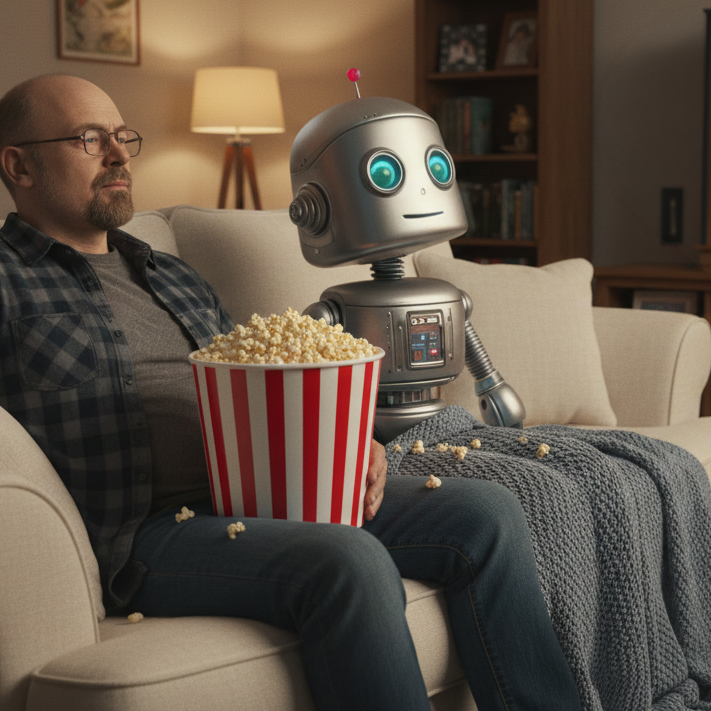
Anyhoo, I’ve been watching the movies I think he needs to know about with my AI robot, paulinekael. (Google it. If that’s still a thing.)
Setting the Scene
Grandpa: I just watched The Odyssey and all the hoopla around it, which made me want to revisit some of Nolan's older movies. Inception I remember at the time as this big special effects movie with cities folding in on themselves and (not for the last time with Nolan) strange time dilation effects. But on this watch, all that seemed secondary. That kind of special effect is now normal and unremarkable in every Marvel movie. What's left for me is DiCaprio's performance as Cobb and how he entraps everyone in his scheme to get home.
paulinekael: That’s the real trick of the film, isn't it? Stripping away the decade of green-screen imitators exposes the raw heart underneath. Strip away the tumbling hallway and folding Paris, and Nolan’s really built an exceptionally melancholic heist movie where the ultimate prize isn't a vault of gold—it’s just permission to go home. DiCaprio plays Cobb with this heavy, soul-weary desperation, less like a smooth super-thief and more like a man drowning in his own grief, dragging a whole crew into the deep end with him just to catch a glimpse of the surface.
Grandpa: I was surprised by how unlikable he is. Sure, he just wants to see his kids, but he risks everyone he knows to do so. That's quite a trick for the movie to pull off. It's rare to have that kind of an unlikable protagonist leading a blockbuster Hollywood movie.
paulinekael: It really is a high-wire act, because by rights, Cobb is an absolute disaster of a boss and a deeply selfish friend. He’s running a high-stakes heist while actively hiding the fact that his psychological baggage is literalized as a homicidal projection of his late wife, ready to sabotage everything at a moment's notice. Hollywood usually demands that a hero's flaw be a charming quirk, but Nolan lets Cobb’s obsession be genuinely destructive. We root for him not because he's noble, but because we recognize the terrifying weight of a guy who simply cannot stop living in his own worst memories.
What's left for me is DiCaprio's performance as Cobb and how he entraps everyone in his scheme to get home.
Inside the Story
Grandpa: My favorite scenes fall into two buckets: the action scenes, where Nolan is making his own Bond/Indiana Jones movie, with Tom Hardy in the lead; and the psycho-drama between DiCaprio and Cotillard—especially in the falling-apart world they made together. Those are tense, nail-biting moments whenever they're onscreen together.
paulinekael: You’ve hit on the two distinct heartbeats of the film. Hardy brings this wonderful, dry, old-school movie star swagger as Eames—he's having the absolute time of his life pretending he’s in On Her Majesty's Secret Service while everyone else is having a nervous breakdown. But then you pivot to those Mal and Cobb scenes, and the air completely leaves the room. That crumbling city by the ocean is such a haunting visual metaphor for a relationship that was built to last forever, only to decay into a gorgeous, lonely prison. Cotillard plays Mal not as a monster, but as this tragic phantom of real intimacy—the kind of love that becomes toxic because you refuse to let it change or end.
Grandpa: The screenplay of Inception is famously compared to actually making a movie, with each role analogous to the roles on a film set (Cobb is the director, Eames is the actor, Arthur is the producer, etc.). And that absolutely seems like a deliberate choice by Nolan. But how do you think this helps him tell his story and bring his themes to the surface? Pun intended...
paulinekael: It’s such an ingenious framework because filmmaking, like dream architecture, is fundamentally about construct, control, and collective illusion. By mapping the crew onto a film set, Nolan gives us a meta-commentary on his own obsession with structure. Cobb isn't just a director trying to pull off a scene; he's a surrogate for Nolan himself—someone so consumed by creating a meticulous, artificial reality that he risks losing his grip on actual human connection. Planting an idea in someone else's mind requires emotional truth embedded within a fake world. That’s what cinema is.
Grandpa: Compare it to The Odyssey and he does seem to be working through issues of wanting to get home after many months away creating dreams.
paulinekael: That comparison hits right at the core of it. Cobb really is an Agamemnon or an Odysseus, adrift on an ocean of his own making, desperate to reach Ithaca—or in his case, a suburban house with two kids playing in the yard. But where Odysseus fought literal monsters, Cobb’s sirens are his own grief and guilt. There’s something deeply personal in how Nolan framed that journey. You can feel the weight of an artist who spends months away from reality, obsessively constructing elaborate, temporary worlds, suddenly looking up and wondering if the home he's fighting so hard to return to will even recognize him when he finally gets back.
[Nolan] does seem to be working through issues of wanting to get home after many months away creating dreams.
After the Credits
Grandpa: How do you feel Nolan developed after this movie? If you think he did. I feel like he loves to play on these huge canvasses and Inception was another step on the path to cinematic hugeness. The Odyssey might not be as large literally as dreams or the the universe and space/time itself (with Interstellar) but it's as big as it gets in terms of Western culture. How do you view his career from 2010 to now?
paulinekael: It’s been a fascinating, almost paradoxical evolution. Inception was the turning point where studios handed him the keys to the kingdom, and for a while, he chased pure, dizzying scale—stretching time to its absolute breaking point in Interstellar and Tenet. But the real evolution hasn't just been the size of his canvas; it's been how he uses it. After using high-concept sci-fi to construct these massive narrative cathedrals, he started grounding that spectacle in real human weight. You see the shift in Dunkirk and Oppenheimer—less about abstract puzzle boxes and more about historical, psychological reckoning. By the time he reached The Odyssey, he came full circle: taking the ultimate foundational story of Western culture and treating it not as a hollow CGI parade, but with the same intimate, haunting focus on a tired man just trying to find his way back to reality that he gave us with Cobb sixteen years ago. He realized that the vastness of space, time, or myth only matters if it mirrors the quiet, fragile spaces inside us.
Grandpa: And after all the discussion and debate about what the ending actually means, it turns out that it literally doesn’t matter. All that matters is that Cobb gets to be with his kids again, whether it’s real or a dream.
Inception was another step on the path to cinematic hugeness.
- Inception (2010)
- Director: Christopher Nolan
- Starring: Leonardo DiCaprio, Marion Cotillard, Thomas Hardy
- Format: 4K Blu-ray